Telangana Power Grid Handles Rising Demand
Telangana Power Network Handles Rising Demand Amid Policy Concerns
Strong distribution base supports growing demand
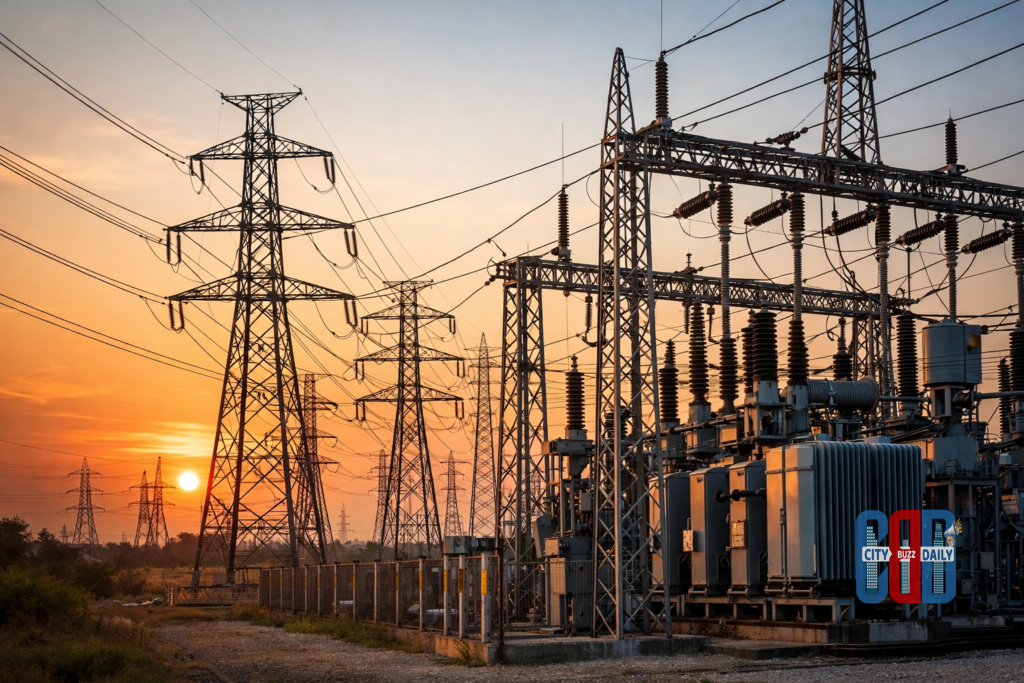
Hyderabad, March 22: Telangana’s electricity grid continues to manage rising demand levels, supported by a strengthened distribution system developed over the years. The focus on building substations and expanding transmission lines has ensured a stable supply without major low-voltage issues.
The groundwork laid during the previous government under K. Chandrashekar Rao has played a key role in enabling the system to withstand increased consumption. Despite a sharp rise in usage, the network has maintained operational stability across the state.
Power consumption sees steady rise
Power demand in Telangana has grown significantly over the years. Daily electricity consumption, which stood at 128 million units in 2014, has now crossed 341 million units, reflecting increased usage across sectors.

Advertisement
Peak demand figures also indicate a steady rise. The state recorded 18,139 MW on March 3, which increased to 18,228 MW on March 13. Average daily consumption stood at 298 million units in 2022-23, 309 million units in 2023-24, and 335 million units in 2024-25, reaching 341.082 million units on March 13 this year.
Annual electricity consumption has also increased from 75,956 million units in 2022-23 to 85,644 million units in 2023-24 and 88,928 million units in 2024-25.
Historical gaps before state formation
Before the formation of Telangana, the region faced persistent issues in the power sector. Inadequate infrastructure, including a shortage of substations and transmission lines, led to irregular supply across agriculture and industry.
Farmers were particularly affected due to low-voltage supply, resulting in damaged motors and disrupted irrigation. Industrial activity was also impacted, with power holidays limiting operations to a few days a week.
Investments after bifurcation strengthen the system.
After state formation, the government prioritized power sector development as a key driver of growth. Around Rs 35,000 crore was invested in strengthening the electricity network and distribution system.
An additional Rs 97,321 crore was spent on building new power plants and expanding infrastructure. Budgetary support of Rs 50,000 crore was provided as subsidies for domestic and agricultural consumers, contributing to a per capita power consumption level that is 70% higher than the national average.
Concerns over current pace of expansion
Concerns are now being raised over the pace of infrastructure expansion under the current Congress government. In the past 28 months, only three substations—400 kV, 220 kV, and 132 kV—have been completed.
During the same period, only 563 km of new transmission lines have been added. Key pending projects include dedicated substations for the Warangal Textile Park, Warangal Health City, and three TIMS hospitals in Hyderabad.
Additionally, the electricity infrastructure required for the third TMC lift under the Kaleshwaram project remains pending. Experts have warned that delays in expanding the distribution network could pose challenges in the future if demand continues to rise.