
Shashi Tharoor Reacts to Digvijaya Singh Row: “Organisation Must Be Strengthened”
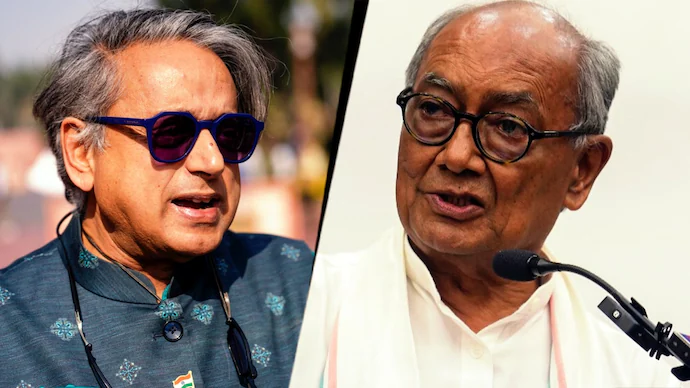
Digvijaya Singh stirred much controversy yesterday with an apparent endorsement of the RSS-BJP in an online article.
Shashi Tharoor Responds to Digvijaya Singh Amid RSS-BJP Praise Controversy
Senior Congress leader Shashi Tharoor stepped into the spotlight on December 28, 2025, amid a growing controversy surrounding party colleague Digvijaya Singh’s remarks that appeared to praise the organisational strength of the Rashtriya Swayamsevak Sangh (RSS) and the Bharatiya Janata Party (BJP). Tharoor offered a measured and diplomatic response, calling attention to internal party reform while emphasising unity and discipline.
Background: Digvijaya Singh’s Remark and the Row
The controversy began when Digvijaya Singh, a veteran Congress leader and former chief minister, shared a black-and-white photograph on social media showing a young Narendra Modi with BJP leader L.K. Advani from the 1990s. Singh highlighted the organisational strength that helped Modi rise from grassroots activism to national leadership, describing it as “the power of the organisation.” This sparked intense political debate because the RSS and BJP have historically been ideological opponents of the Congress.
BJP leaders quickly seized on Singh’s post to criticise the Congress and its leadership structure, using it to argue that the party suffers from internal weaknesses and autocratic control. Within the Congress, reactions varied — some leaders condemned the comparison with the RSS, while others focused on the broader issue Singh raised about organisational reform. www.ndtv.com

Advertisement
Singh later clarified that his comment should not be interpreted as an endorsement of RSS or BJP ideology, asserting that he remains firmly opposed to their views despite acknowledging their organisational effectiveness.
Shashi Tharoor’s Response
When asked about Digvijaya Singh’s controversial remarks during the 140th Congress Foundation Day event, Shashi Tharoor responded with careful diplomacy. He underlined the need for strengthening the party organisation and stressed the importance of discipline within the Congress, without directly engaging in the ideological debate over RSS or BJP.
Tharoor said:
“We are friends and talk to each other. The organisation must be strengthened — there is no question about it.”
He acknowledged that internal discussions among party colleagues are natural, especially when considering the long legacy of the Congress. Tharoor emphasised that internal strength and discipline are vital for the party’s future success and political relevance.
In further remarks covered by the press, Tharoor suggested that while the Congress has a rich history spanning over 140 years, it must continue to evolve and look inward to fortify its grassroots structure and organisational coherence. His message was not crafted as a direct endorsement of Singh’s praise of rival organisations, but rather as an affirmation that calls for reform should be examined in the context of strengthening the party.
Division Within the Congress
Tharoor’s comments revealed a subtle divide in the Congress’s response to the row. Some leaders, including Tharoor, echoed the sentiment that organisational reform and internal strength are crucial. In contrast, others — such as party spokesperson Pawan Khera — took a firmer ideological position, rejecting any comparison between the Congress and the RSS. Khera reportedly questioned the merit of learning from an organisation whose ideology he criticised, especially in light of historical tensions between the parties.
Other voices within the party stressed unity and downplayed the controversy, suggesting that differences of opinion can coexist within a democratic political organisation.
Political and Public Reaction
Outside the Congress, the controversy quickly became political fodder. Opposition parties, particularly leaders from the BJP, used Singh’s remarks to criticise the Congress’s internal functioning and leadership dynamics. The BJP characterised the post as exposing weaknesses in the Congress’s organisational structure and argued that Singh’s comments represented deeper discontent within the party.
Meanwhile, other politicians and public figures weighed in from different perspectives. Some commentators noted that Singh’s praise of organisational strength — even in a limited context — highlighted broader questions about how political parties maintain coherence, discipline, and grassroots engagement in a competitive landscape.
Shashi Tharoor’s response to the Digvijaya Singh row aimed to balance internal party unity with acknowledgement of the need for organisational reform. While he did not focus on the ideological aspects of the controversy, his emphasis on strengthening the party’s structure and discipline underscores longstanding concerns about political effectiveness within the Congress. As this debate continues to unfold, the row may serve as a catalyst for introspection about intra-party dialogue and strategy ahead of future political challenges.