IRGC Directs Iran Strategy in War With US and Israel
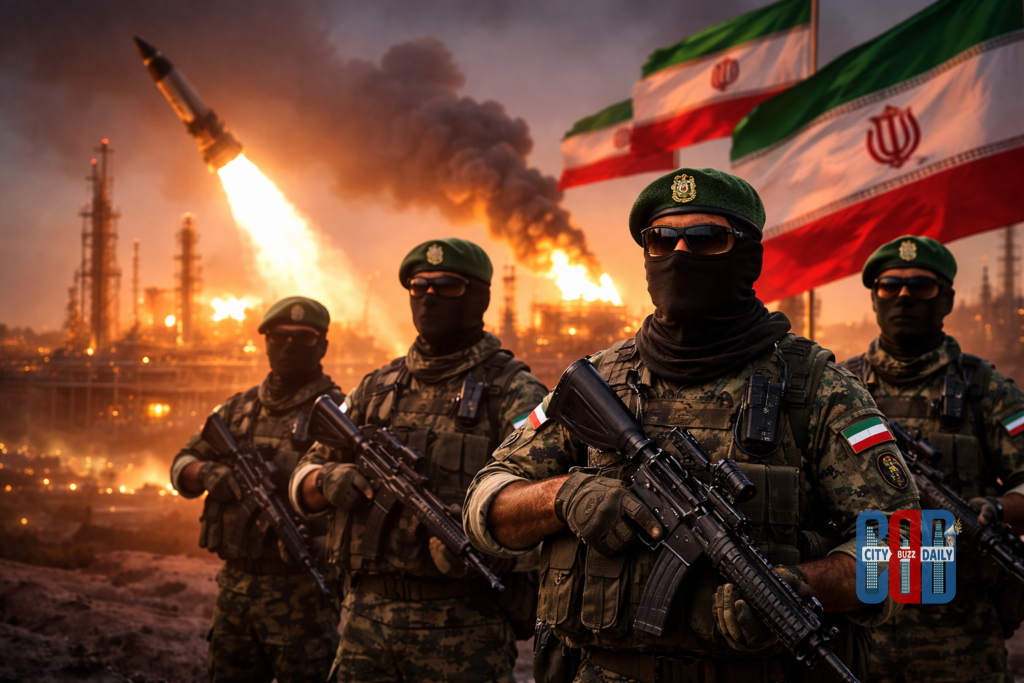
Islamic Revolutionary Guards Corps Directs Iran’s Endurance Strategy in War
Iran is pursuing a strategy focused on endurance in its confrontation with the United States and Israel, aiming to prolong the conflict rather than secure a rapid military victory. The approach centres on sustained missile and drone attacks, disruption of energy routes, and pressure on global markets.
Officials and analysts say Tehran believes economic disruption and prolonged conflict could test Washington’s political resolve and shift the balance of pressure over time.
IRGC Maintains Operational Control
The Islamic Revolutionary Guards Corps (IRGC) remains firmly in control of Iran’s war strategy despite the shock of U.S.–Israeli strikes and the loss of key figures in the opening phase of the conflict.

Advertisement
The Guards are directing battlefield operations, executing contingency plans, and determining strategic targets. Their authority has also extended into the political sphere following leadership changes after Ayatollah Ali Khamenei was killed in the initial strikes.
According to insiders, the IRGC played the decisive role in elevating Mojtaba Khamenei as supreme leader, reinforcing its position as the dominant force shaping the direction of the Islamic Republic.
Escalating Strikes Target Energy Infrastructure
Iran has intensified attacks across the Gulf, with energy hubs in countries such as Qatar and Saudi Arabia emerging as major targets. The objective appears to be economic disruption that raises costs for neighbouring states, Europe, and the United States.
Analysts say the strategy reflects an attempt to increase pressure on Western governments by driving volatility in energy markets and global financial systems.
Fawaz Gerges of the London School of Economics described the conflict as an existential fight for Iran’s leadership. Alex Vatanka, a senior fellow at the Middle East Institute, noted that the country may become more unpredictable as it absorbs losses while continuing military operations.
United States Signals Continued Military Campaign
U.S. President Donald Trump told Republican lawmakers that the military campaign would continue until Iran is “totally and decisively defeated.” He also predicted the conflict would conclude soon.
Trump stated that once operations are completed, Iran would not retain weapons capable of threatening the United States, Israel, or American allies for a prolonged period.
Missile Stockpiles Remain a Key Factor
A central question in the conflict is how long Iran can sustain its missile campaign, which forms the backbone of its military strategy.
U.S. officials say a large share of Iran’s arsenal has already been destroyed. However, regional sources suggest Tehran may still possess more than half of its pre-war missile stockpile.
If that estimate is accurate, Iran could continue launching missiles for several weeks, potentially extending the conflict as economic pressures grow internationally.
War Economy and Domestic Stability
The conflict is also reshaping internal governance. Observers say administrative procedures have been streamlined, with goods cleared quickly through ports and documentation handled later.
Officials describe this as preparation for a wartime economic environment designed to keep supply chains functioning under pressure.
Despite continued bombardment, reports from Tehran indicate that daily life is continuing. Shops and banks remain open, and supplies are available, while most residents have not left the capital.
Analysts say the strikes may also be strengthening national unity. Even critics of the government appear to be rallying around the state as infrastructure comes under attack.
Conflict Framed as Test of Endurance
Strategists on both sides increasingly view the war as a test of endurance. Iran’s leadership is attempting to sustain missile attacks while applying economic pressure through disruptions to global energy markets.
At the same time, the United States and Israel face the challenge of maintaining military operations and managing the economic and political costs of the campaign.
For Tehran, survival itself could be presented as a strategic victory even if significant military infrastructure is destroyed. Analysts warn that the outcome may leave a weakened but potentially more unpredictable Iran in the region.