
Indian Stock Markets Fall 3% After Global Crude Oil Surge
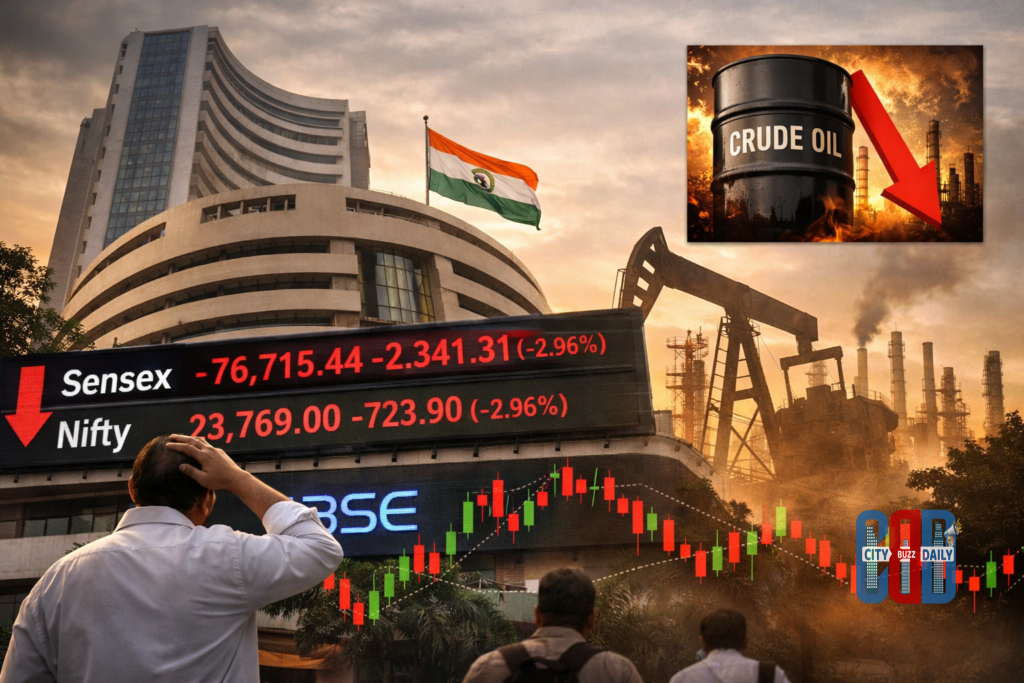
Indian Stock Markets Slide Nearly 3% After Crude Oil Surge
Indian equity markets opened sharply lower on March 9, 2026, with benchmark indices declining nearly 3% following a surge in global crude oil prices. Heavy selling by investors at the opening bell pushed both the Nifty and Sensex into one of their weakest levels in almost six months.
Nifty opened at 23,868.05 points while the Sensex began trading at 77,056.75 points. By 9:37 a.m., the indices had fallen further, with Nifty at 23,769 points and Sensex at 76,715.44 points.
Market data showed widespread selling pressure across most stocks, with only a few hundred scrips trading in the green since the market opened at 9:00 a.m.
Crude Oil Shock Triggers Market Reaction

Advertisement
The market decline follows a sharp increase in global crude oil prices. Brent crude surged beyond $115 a barrel after Iran reportedly shut down the Strait of Hormuz, a critical maritime route that supplies roughly one-fifth of India’s oil requirements.
The move came in retaliation to attacks by the United States and Israel on Iran and the assassination of Iranian leader Ayatollah Khamenei. The closure of the strategic waterway triggered fears of a prolonged supply disruption in global oil and natural gas markets.
Analysts say the surge in crude prices has triggered concerns about inflation and broader economic impacts, particularly for oil-import dependent economies like India.
Supply Concerns Add Uncertainty
Apart from pushing prices higher, the blockade has raised fears about sustained supply disruptions. Experts warn that if the conflict in West Asia continues for an extended period, energy supply constraints could affect industries that depend heavily on fuel availability.
The uncertainty around oil supply has already reflected in stock market behaviour. Almost all sectoral indices opened lower and continued to trade below their previous closing levels during early trade.
Investors reacted cautiously amid fears that higher energy costs could ripple through several sectors of the economy.
Impact on Inflation and Foreign Investors
Market experts note that the oil shock could translate into higher inflation in the coming months. This could happen regardless of whether the increase in crude prices is fully passed on to consumers.
Foreign institutional investors (FIIs), who had briefly resumed buying in February, have reportedly returned to aggressive selling in the Indian market as geopolitical uncertainty intensifies.
However, analysts point out that geopolitical conflicts historically have had only short-term effects on equity markets.
Sectors Likely to Remain Stable
According to market observers, domestic consumption-driven sectors such as banking and financials, automobiles, telecom and cement may see limited direct impact from the current crisis.
Defence and pharmaceutical sectors are also expected to remain relatively resilient amid the ongoing geopolitical developments.
Experts suggest that long-term investors with a higher risk appetite may consider selective investments in fundamentally strong sectors while the market remains volatile.