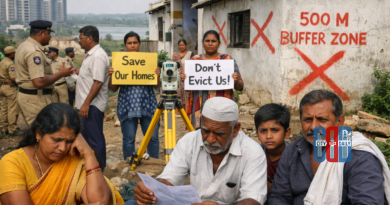
HYDRA Demolition Policy Faces Criticism
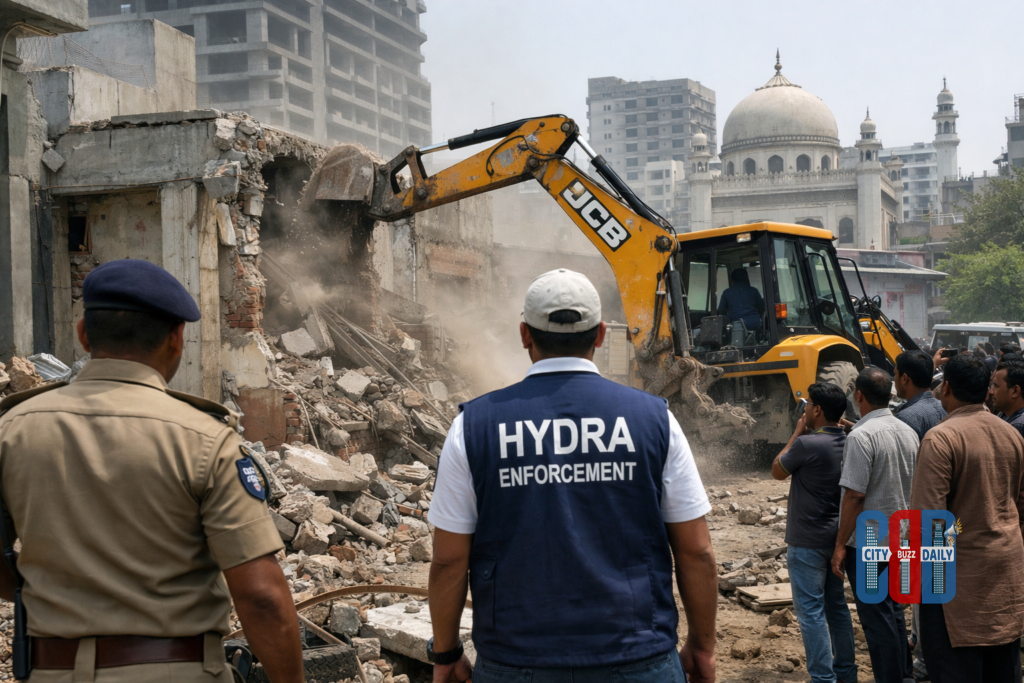
HYDRA Commissioner Faces Criticism Over Demolition Policy, Gives Clarifications
Allegations of selective action trigger public debate
Hyderabad, March 22: HYDRA’s demolition drive has come under scrutiny following allegations of selective action against illegal constructions. Questions are being raised over why houses of economically weaker sections are being demolished while larger encroachments remain untouched.
During a recent media interaction, HYDRA Commissioner Ranganath offered varied explanations on multiple issues, drawing criticism across social media platforms. His responses have triggered debate on the consistency of enforcement.
Questions over unequal enforcement
Concerns were raised over demolitions targeting smaller residential structures while alleged encroachments by influential individuals remain intact. When asked about constructions in areas such as Salkam Cheruvu and Gandipet lake, the Commissioner responded that action would be taken if specific locations were shown.

Advertisement
On the issue of a college reportedly constructed in the middle of Salkam Cheruvu, the Commissioner avoided a direct answer and stated that the agency does not consider political affiliations while taking action. He cited demolitions at Bam Rukn Ud Daula Lake as examples of enforcement.
Data gaps and demolition figures questioned
The Commissioner’s inability to provide a clear number of demolished houses has also drawn attention. While it was mentioned that around 30,000 people were affected, he stated that only about 300 houses were demolished, later adding that the figure could be below 150.
He maintained that only structures built with “illegal permissions” were targeted, not those approved by the government. However, concerns remain as several affected residents claim their constructions were based on official approvals.
Impact on affected residents
Residents have questioned the accountability of authorities when approved constructions are later declared illegal. In several instances, individuals who built or purchased homes based on official permissions are now facing demolitions and financial liabilities.
Cases have also been cited where families were evicted without being allowed to collect belongings. The Commissioner acknowledged that mistakes occurred in the initial months after HYDRA’s formation in July 2024 and said corrective steps were taken.
Long-standing encroachments remain unaddressed
Attention has also been drawn to alleged large-scale encroachments identified earlier by Deputy Chief Minister and Finance Minister Bhatti Vikramarka. These include projects worth around Rs 15,000 crore reportedly constructed in lake buffer zones and Full Tank Level (FTL) areas.
Despite official presentations and documentation, questions persist over why HYDRA has not acted against such high-value constructions. Similar concerns have been raised regarding alleged encroachments in Khajaguda involving significant land value.
Policy stance and public reaction
The Commissioner stated that demolitions have helped curb fresh encroachments, claiming that people are now hesitant to invest in illegal layouts. He also remarked that strict enforcement, including creating fear, has contributed to compliance.
This stance has drawn criticism, with questions raised on whether governance should rely on deterrence through fear rather than public assurance. The remarks, along with inconsistent responses during the interview, have intensified calls for transparency and uniform enforcement in demolition drives.