CBSE Introduces On-Screen Marking for Class 12 Exams
CBSE Introduces Digital Evaluation for Class 12 Answer Books
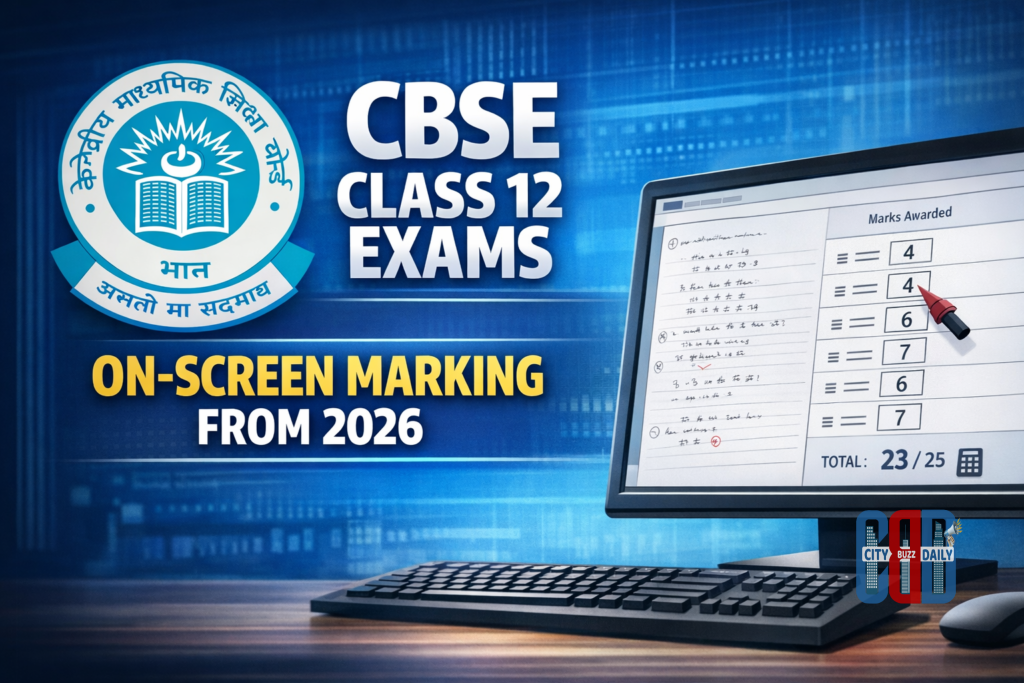
The Central Board of Secondary Education (CBSE) has decided to implement On-Screen Marking (OSM) for the evaluation of Class 12 answer scripts beginning with the 2026 board examinations. The move marks a shift towards digital processing in the Board’s evaluation system, aimed at improving speed and transparency. Class 10 answer books, however, will continue to be evaluated through the conventional physical method in 2026.
CBSE conducts board examinations for Classes 10 and 12 across India and 26 other countries, covering nearly 46 lakh students each year. The evaluation process has traditionally been large-scale and time-consuming, prompting the Board to adopt digital solutions.
Board Explains Rationale Behind On-Screen Marking

Advertisement
Controller of Examinations Dr. Sanyam Bhardwaj confirmed that the introduction of on-screen marking is part of CBSE’s continued efforts to strengthen efficiency and transparency in the evaluation process. In an official communication dated February 9, 2026, the Board stated that digital evaluation would streamline procedures and reduce reliance on manual work.
CBSE outlined several advantages of the new system. The digital process allows faster evaluation with broader participation of teachers from affiliated schools. Automatic calculation of marks will eliminate totaling errors, while digital coordination will minimize manual intervention and related mistakes.
The Board also noted that the system will remove the need for post-result verification of marks, thereby reducing delays after results are declared. It is expected to lower manpower requirements for verification work and cut transportation costs, as physical answer books will no longer need to be moved between locations.
Teachers to Evaluate From Their Own Schools
Under the On-Screen Marking system, teachers will be able to evaluate answer scripts from their own schools while continuing regular duties. The platform will also allow participation of teachers from CBSE-affiliated schools worldwide, expanding evaluation capacity beyond geographical limits.
The digital method is also positioned as an environmentally friendly measure, supporting CBSE’s push towards sustainable practices in examination management.
Technical Requirements for Schools
CBSE has directed schools to ensure technical readiness before implementation. Institutions must have a computer lab with a public static IP as per affiliation bylaws. Systems should run on Windows OS 8 or above with at least 4 GB RAM and 1 GB free space on the C drive. Updated browsers such as Chrome, Edge, Firefox, or Internet Explorer must be installed, along with Adobe Reader.
Schools must also ensure reliable internet connectivity with a minimum speed of 2 Mbps and an uninterrupted power supply to support continuous digital evaluation.
Training and Support Measures Planned
To facilitate the transition, CBSE will allow teachers with OASIS IDs to log in and familiarize themselves with the platform. Multiple dry runs and training programs will be conducted to help teachers practice digital evaluation. The Board also plans to establish a dedicated call center and release instructional videos for step-by-step guidance.
Detailed operational instructions will be issued separately to ensure timely preparation by all stakeholders.
Board Exam Schedule for 2026
CBSE Board examinations for Classes 10 and 12 will begin on February 17 and conclude on April 10. The Board has also decided to conduct the Class 10 examination twice a year. The second session will be held from May 15 to June 1, following the same syllabus. Appearing in the first examination starting February 17 will remain mandatory for students.
👉 For more breaking news updates, in-depth reports, and real-time developments from across India, visit the City Buzz Daily homepage.