
Air Freight Rates Surge After Middle East Conflict Disrupts Routes
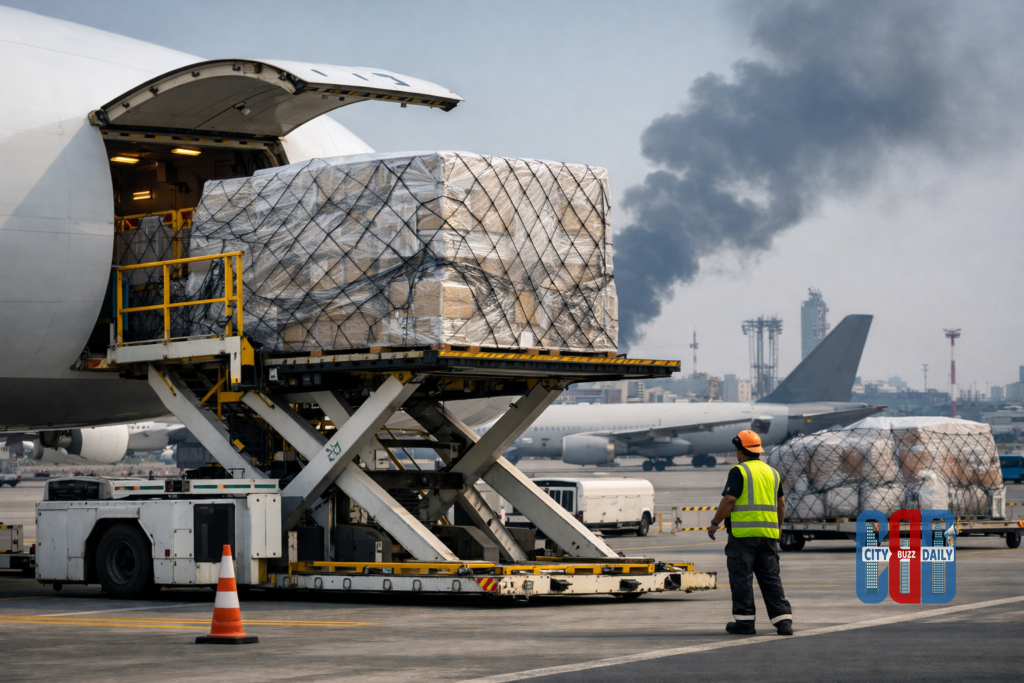
Air Freight Rates Rise Sharply as Middle East Conflict Disrupts Trade Routes
Air freight rates on several international routes have increased sharply following the start of the U.S.-Israeli war on Iran, according to industry data. The conflict has disrupted key shipping and aviation corridors across the Middle East, forcing airlines and logistics firms to adjust routes and operations.
The disruptions have affected both air and ocean cargo movement, particularly around the Strait of Hormuz, a critical oil export corridor. More than 100 container ships have reportedly been stranded in the surrounding region due to security concerns and operational restrictions.
South Asia–Europe Routes Face Strongest Impact
Industry experts say routes connecting South Asia and Europe have experienced the most significant impact. Airspace closures and security restrictions across parts of the Middle East have reduced available flight capacity, forcing airlines to reroute cargo flights through longer paths.

Advertisement
Freight booking platform Freightos reported that off-contract spot air cargo rates from South Asia to Europe have risen 70%, reaching $4.37 per kg compared with $2.57 per kg before the conflict began.
Rates between South Asia and North America have increased 58% to $6.41 per kg, while shipments between Europe and the Middle East have risen 55% to $2.79 per kg.
Supply Chains Shift from Sea to Air
The disruptions in maritime transport have also affected industries dependent on sea shipments through the Strait of Hormuz. Pharmaceutical supply chain expert Prashant Yadav said products such as inexpensive generic medicines from India normally move via container ships through the corridor to markets including the European Union, Africa, Saudi Arabia and the United Arab Emirates.
However, with shipping routes affected, some companies are shifting to air cargo for urgent deliveries.
Yadav, a senior fellow at the Council on Foreign Relations, said the primary change involves pharmaceutical companies moving generic medicines from ocean freight to air transport to maintain supply continuity.
Air cargo plays a critical role in global commerce, accounting for roughly one-third of global trade by value. Higher freight rates therefore have the potential to influence the pricing of goods including fresh food, pharmaceuticals and electronics.
Rising Fuel Costs and Capacity Constraints
Logistics experts say rising costs and limited cargo capacity are further pushing up air freight rates.
Steve Blough, chief supply chain strategist at logistics software firm Infios, said moving goods by air is typically five to ten times more expensive than ocean shipping, and costs have continued rising as capacity tightens.
In many cases, companies are transporting limited quantities by air to temporarily bridge supply gaps.
Jet fuel prices have also surged since the start of the conflict, with costs reportedly doubling during the period.
Container shipping giant Maersk confirmed that its air cargo services are now applying additional fuel surcharges and war risk levies due to the situation.
Middle East Cargo Hubs Face Operational Limits
Major regional cargo hubs including Dubai and Doha have also faced operational disruptions due to the conflict. Reduced operations at these airports have limited transshipment capacity and affected cargo routing.
Niall van de Wouw, chief air freight officer at pricing platform Xeneta, said the rate increases were largely driven by a sharp reduction in cargo capacity at key Middle East hubs.
Cathay Pacific Airways CEO Ronald Lam said many of the airline’s freighter flights to Europe typically stop in Dubai for refuelling and additional cargo. Due to current conditions, the airline has been skipping the stop and flying directly from Hong Kong to Europe with payload restrictions.
Freightos research head Judah Levine noted that a significant portion of South Asia’s air cargo exports normally transit through Gulf hubs. Some shipments are now being rerouted through East Asia.
He added that rate increases have recently started to stabilise, with some carriers in Asia and Europe adding additional long-haul capacity. Certain Gulf airlines, including Emirates, have also begun restoring operations and increasing flight movements at regional hubs.