US-Israel Strikes Intensify as Iran War Enters Day 11
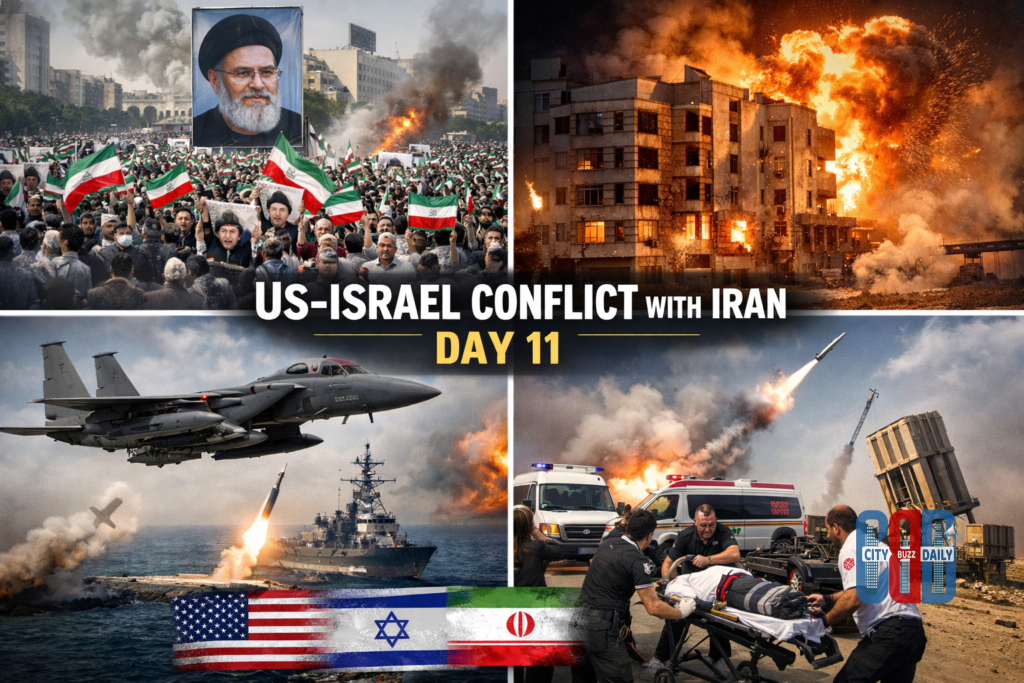
United States-Israel conflict with Iran enters second week with continued strikes
The conflict involving the United States, Israel, and Iran entered its eleventh day with intensified overnight bombardments reported across several Iranian locations. Tehran experienced some of the most intense attacks since the beginning of the military operations, according to multiple reports emerging from the region.
US President Donald Trump stated on Monday that the conflict could end “pretty quickly”, although he clarified that the war would not conclude this week. Trump also expressed dissatisfaction with Iran’s new Supreme Leader Mojtaba Khamenei, who recently succeeded his father Ayatollah Ali Khamenei.
Large rallies in Tehran amid ongoing strikes
Despite continued air strikes, hundreds of thousands of Iranians gathered in Tehran to demonstrate support for Mojtaba Khamenei. Supporters described the rally as a sign of defiance against the ongoing military campaign led by the United States and Israel.

Advertisement
Iranian Foreign Minister Abbas Araghchi said the country would continue fighting for as long as necessary. His remarks suggested that Tehran does not expect the conflict to end soon, contradicting claims from Washington that the situation could stabilise quickly.
Civilian casualties and damage across Iranian cities
Iranian state-linked ISNA news agency reported that a US-Israeli air strike struck a residential building in Arak, a city in western Iran, killing five people and injuring several others. Another attack on residential buildings in eastern Tehran reportedly killed at least 40 people.
Earlier strikes on oil facilities also caused heavy smoke to spread across the capital. Iranian authorities say the war has killed more than 1,255 people and injured around 10,000 since the conflict began.
Iran’s parliament speaker Mohammad Bagher Ghalibaf warned of a “harsh response” to attacks on civilian residential areas. Meanwhile, the Ministry of Foreign Affairs accused the United States of attempting to partition the country and seize oil resources.
Regional tensions spread across Gulf countries
The conflict is also affecting several Gulf nations. Kuwait, the United Arab Emirates, Saudi Arabia and Bahrain reported intercepting Iranian missiles and drones on Tuesday.
Saudi Arabia said its military destroyed a drone east of al-Kharj governorate. Another drone reportedly fell on a residential site in Az Zulfi city in Riyadh province, causing limited material damage but no injuries.
In Bahrain, authorities confirmed that a residential building in Manama was struck, killing a 29-year-old woman and injuring eight others. Gulf Air announced that all flights remain temporarily suspended as Bahrain’s airspace continues to be closed.
Military developments in Israel and the United States
Iran’s army said it launched drone attacks targeting an Israeli oil and gas refinery and fuel tanks in Haifa. The Israeli military reported detecting missile launches from Iran and said interception efforts were underway.
Near Tel Aviv’s international airport, ambulance services confirmed that one man died from shrapnel injuries at a construction site. Israeli authorities say the total death toll from Iranian attacks has now reached 11.
In the United States, Trump told lawmakers that American forces have struck more than 5,000 targets in Iran. He claimed these attacks destroyed Iran’s navy and air force and eliminated 80–90 percent of its missile launchers.
Trump also confirmed a seventh US combat death and said the United States continues to seek what he called “ultimate victory”.
Energy markets and global response
The conflict has triggered major disruptions in global energy markets. Bombardment of Iranian oil infrastructure pushed oil prices sharply higher before they later dropped to around $90 a barrel.
Leaders across the world are monitoring the economic fallout. Russia’s President Vladimir Putin said Moscow is ready to cooperate with European customers to manage a potential global energy crisis.
France’s President Emmanuel Macron also confirmed that France and its allies are preparing a mission to reopen the Strait of Hormuz, a key global oil shipping route affected by the conflict.
G7 finance ministers have meanwhile said they are prepared to release energy stockpiles to stabilise global markets if the crisis continues.