
Oil Prices Cross $100 as US–Israel War Hits Supply
Oil Prices Cross $100 as US–Israel War on Iran Disrupts Supply
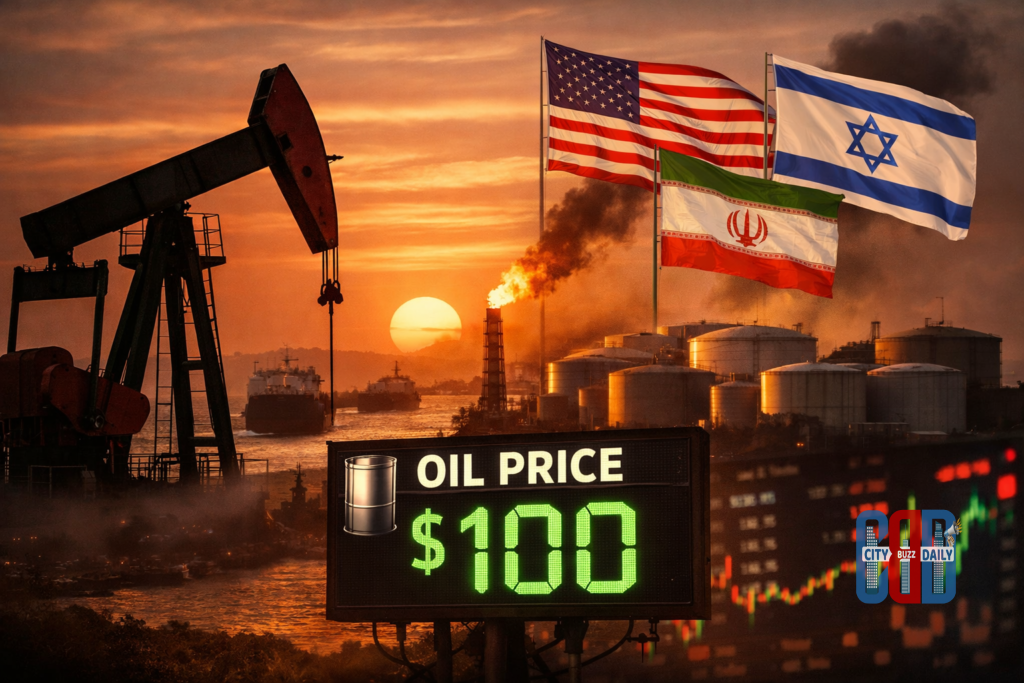
Global crude oil prices surged past $100 per barrel as tensions escalated in the Middle East following the United States and Israel’s war on Iran. The sharp rise reflects growing concerns over disruptions to global energy supplies amid the widening regional conflict.
Brent crude, the international benchmark, climbed more than 20 percent on Sunday and briefly crossed $114 per barrel. By 02:30 GMT on Monday, prices moderated slightly but remained elevated at around $107.50 per barrel.
The jump marks the first time crude prices have crossed the $100 mark since Russia’s invasion of Ukraine in 2022.
Strait of Hormuz Disruption Raises Supply Concerns
Oil markets reacted strongly after Iran effectively halted shipping through the Strait of Hormuz in retaliation for the attacks. The waterway is a critical global route through which roughly one-fifth of the world’s oil supply moves.

Advertisement
The disruption has created a backlog of oil shipments across the region. Major producers including Iraq, the United Arab Emirates and Kuwait have cut production as vessels remain unable to move supplies through the blocked route.
Energy infrastructure in the Gulf region has also come under threat. Iran has been blamed for multiple attacks targeting energy facilities in Qatar, Saudi Arabia and Kuwait, adding to concerns about prolonged supply disruptions.
Israel Targets Iranian Oil Infrastructure
On Saturday, Israel carried out air strikes on Iran’s oil infrastructure for the first time since the conflict began. Iranian state media reported that four oil storage facilities and an oil production transfer centre in Tehran and the province of Alborz were hit during the attacks.
Iran’s Islamic Revolutionary Guard Corps (IRGC) responded on Sunday by warning that energy infrastructure across the region could be targeted if hostilities continue.
The IRGC also warned that oil prices could rise as high as $200 per barrel if the United States and Israel continue military operations.
US Officials Downplay Price Spike
Despite the sharp rise in oil prices, US officials have played down the long-term impact.
US President Donald Trump said the surge in prices would be temporary and linked it to the broader goal of eliminating Iran’s nuclear threat. In a post on Truth Social, Trump said the short-term rise in oil prices was “a very small price to pay for U.S.A., and World, Safety and Peace.”
US Secretary of Energy Chris Wright also said any increase in petrol prices would likely be temporary.
Global Markets React to Rising Energy Costs
Financial markets reacted sharply to the surge in energy prices. Stock markets across Asia fell significantly during early trading on Monday.
Japan’s Nikkei 225 dropped more than 7 percent, while South Korea’s KOSPI declined by more than 8 percent. Hong Kong’s Hang Seng Index also slipped nearly 3 percent.
US stock futures indicated further pressure, with contracts linked to the S&P 500 falling 1.7 percent and Nasdaq Composite futures dropping about 1.90 percent.
Inflation and Growth Concerns
The sharp increase in oil prices has renewed concerns about inflation and economic growth worldwide.
The International Monetary Fund estimates that every sustained 10 percent rise in oil prices leads to a 0.4 percent increase in inflation and reduces global economic growth by around 0.15 percent.
Market analysts say the longer the disruption continues, the greater the pressure on the global economy.
Qatar’s Energy Minister Saad al-Kaabi recently warned that regional producers may soon be forced to halt production entirely if the conflict continues. He also indicated that oil prices could reach $150 per barrel if the situation worsens.






Pingback: Oil Prices Surge to $119 as War Lifts Sugar Markets