Union Budget 2026-27 Sets Three-Kartavya Growth Framework
Union Budget 2026–27 sets a three-kartavya framework for growth and inclusion
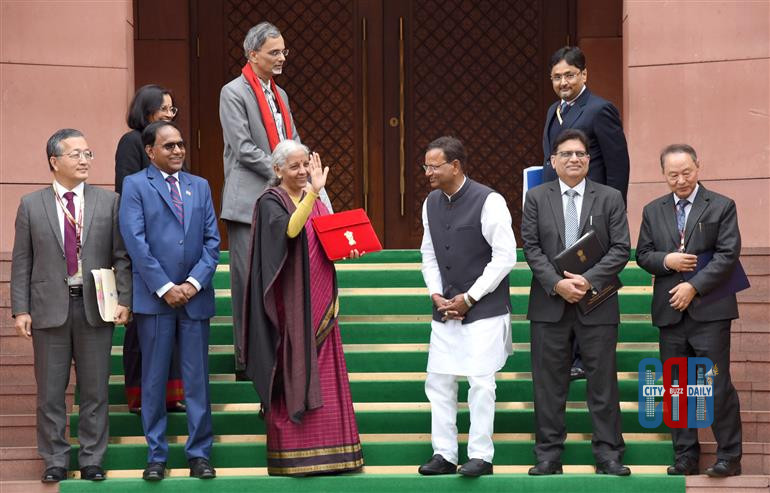
The Union Budget 2026–27 was presented in Parliament on Saturday by Union Minister for Finance and Corporate Affairs Nirmala Sitharaman, marking the first Budget prepared at Kartavya Bhawan. The Finance Minister said the Budget is guided by three “kartavya”, or duties, aimed at sustaining economic momentum while widening participation in growth.
The three priorities outlined include accelerating and sustaining economic growth, fulfilling people’s aspirations by building capacity, and ensuring inclusive development aligned with the vision of Sabka Sath, Sabka Vikas.
Growth push through manufacturing, infrastructure, and cities

Advertisement
Under the first Kartavya, the Budget proposes interventions across six areas, including scaling manufacturing in seven strategic sectors, rejuvenating legacy industries, creating “Champion MSMEs”, boosting infrastructure, ensuring long-term energy security, and developing city economic regions.
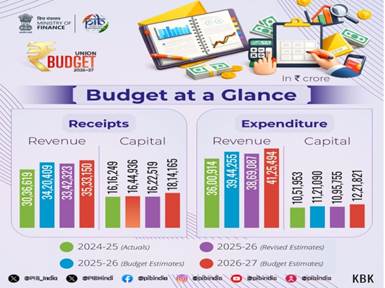
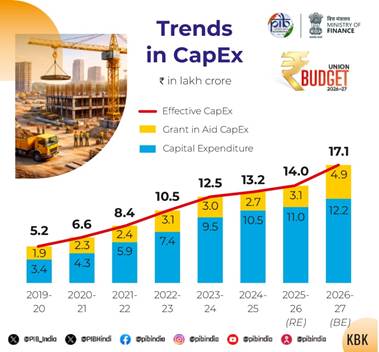
Public capital expenditure has been increased to ₹12.2 lakh crore for 2026–27 from ₹11.2 lakh crore in the previous Budget Estimates. The government also announced seven high-speed rail corridors to be developed as growth connectors, including Mumbai–Pune, Delhi–Varanasi, and Chennai–Bengaluru.
To strengthen domestic manufacturing, the Budget announced Biopharma SHAKTI with an outlay of ₹10,000 crore over five years to support the production of biologics and biosimilars. A ₹10,000 crore SME Growth Fund has also been proposed to nurture MSMEs as future champions.
Capacity building in education, tourism, and sports
The second kartavya focuses on capacity building across sectors. In higher education, one girls’ hostel will be established in every district to support women students in STEM institutions. The Indian Institute of Creative Technologies, Mumbai, will support AVGC content creator labs in 15,000 secondary schools and 500 colleges.
The government also announced a pilot scheme to upskill 10,000 tourist guides across 20 sites through a 12-week hybrid training programme in collaboration with an Indian Institute of Management. A Khelo India Mission has been proposed to transform the sports sector over the next decade through talent development, infrastructure and integration of sports science.
Inclusive development and fiscal consolidation
Aligned with the third kartavya, the Budget announced Bharat-VISTAAR, a multilingual AI-based system to integrate AgriStack portals with ICAR agricultural practices. Measures were also outlined for mental health care, including the establishment of NIMHANS-2 and upgrades to national mental health institutes.
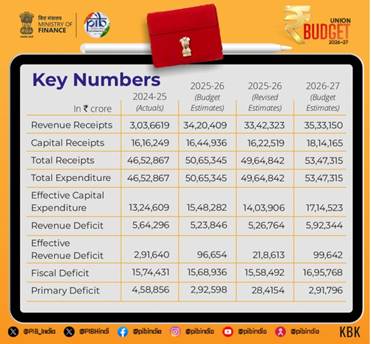
On the fiscal front, the government estimated the fiscal deficit at 4.3 per cent of GDP for 2026–27, with the debt-to-GDP ratio projected to decline to 55.6 per cent. Net market borrowings are estimated at ₹11.7 lakh crore to finance the deficit.
Tax reforms and customs rationalisation
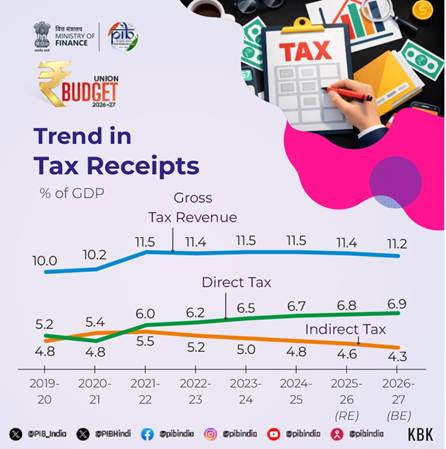
The New Income Tax Act, 2025, will come into effect from April 2026, with simplified rules and redesigned forms to be notified shortly. The Budget proposes rationalisation of penalties and prosecution, higher safe harbour thresholds for IT services, and a tax holiday until 2047 for foreign cloud service providers operating from India.
On the indirect tax front, customs duty exemptions were announced for capital goods used in lithium-ion battery manufacturing, critical minerals processing, and 17 drugs or medicines. The tariff rate on dutiable personal imports has been reduced from 20 per cent to 10 per cent.
👉 For more breaking news updates, in-depth reports, and real-time developments from across India, visit the City Buzz Daily homepage.