
PSLV Mission Faces Setback Again as ISRO Probes Third-Stage Anomaly
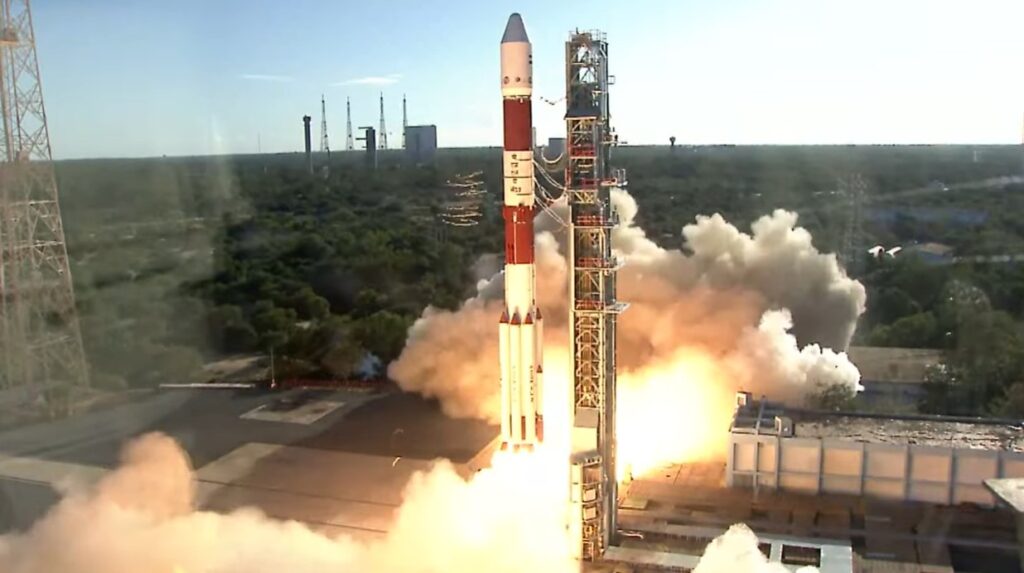
Sriharikota/New Delhi: India’s trusted workhorse launch vehicle, the Polar Satellite Launch Vehicle (PSLV), faced fresh uncertainty on Monday after its latest mission encountered a technical anomaly mid-flight, raising concerns over the fate of 16 satellites carried onboard.
Launch Proceeds Smoothly Before Trouble Emerges
The 64th PSLV mission, designated PSLV-C62, lifted off from the Satish Dhawan Space Centre at 10:18 am, carrying the Earth observation satellite EOS-N1 along with multiple secondary payloads. The mission was closely watched as a critical return-to-flight effort for the rocket after its failure in 2025.
Officials said the launch began on a nominal note, with both the first and second stages performing as expected in the initial phase of ascent.
Deviation Detected During Third Stage
The situation changed during the third stage of the flight, when telemetry data indicated a deviation from the planned trajectory. Indian Space Research Organisation (ISRO) confirmed the anomaly but stopped short of declaring the mission unsuccessful.

Advertisement
ISRO Chairman Dr V Narayanan said mission data is under detailed analysis and that a formal statement will be issued once the review is complete. He acknowledged that the vehicle was unable to proceed along the expected path.
Historically, issues arising in the third stage of a PSLV mission have often resulted in near-total mission loss.
A Key Comeback Attempt
PSLV-C62 was intended to restore confidence in the launch vehicle following its lone mission in 2025, which also failed during the third stage. ISRO had constituted a failure analysis committee after that incident, though its findings were not made public.
Despite the unresolved questions surrounding the earlier failure, PSLV-C62 was cleared as ISRO’s first launch of 2026.
16 Satellites Onboard
The mission carried a total of 16 satellites, including EOS-N1 and Anvesha, a surveillance satellite developed by the Defence Research and Development Organisation (DRDO). Several international payloads from Brazil, Nepal, and the United Kingdom were also part of the mission.
Implications for ISRO and Private Space Firms
If declared unsuccessful, PSLV-C62 would mark the fifth failure in the rocket’s 64-flight history. While the overall reliability record remains strong, another setback would be significant for India’s space programme, particularly at a time when commercial launches are gaining momentum.
Indian space startups are among those affected. Hyderabad-based Dhruva Space had seven satellites aboard the mission, making it one of the largest commercial participants.
The PSLV plays a central role in India’s commercial launch ambitions, including plans to field the first industry-manufactured PSLV through a consortium led by Hindustan Aeronautics Limited and Larsen & Toubro.
Awaiting Official Outcome
ISRO has not yet categorised PSLV-C62 as either a success or failure. However, the confirmation that the mission deviated from its intended flight path has raised doubts about whether its objectives were achieved.
The final assessment, once announced, is expected to have far-reaching consequences not only for ISRO’s launch schedule but also for the growing number of domestic and international customers relying on the PSLV platform.