Maduro’s Hidden Spiritual Bond With India
A global controversy brings an unexpected spiritual connection into focus
Recent developments surrounding Venezuelan President Nicolás Maduro have once again placed him at the center of global attention. While international focus remains fixed on allegations, sanctions, and escalating geopolitical tensions, a lesser-known aspect of Maduro’s personal life has resurfaced—his spiritual link with India. This connection, rooted in devotion rather than diplomacy, traces back to the late Indian spiritual leader Sathya Sai Baba, revealing a dimension of Maduro that stands apart from the political narrative dominating headlines.
US allegations and rising tensions in Latin America
The United States administration has intensified accusations against Maduro and his wife Cilia Flores, alleging involvement in a transnational narcotics network. According to international reports, US authorities claim the Venezuelan leadership collaborated with criminal organizations operating across Latin America. These developments have coincided with heightened military activity, described by analysts as one of the most significant US interventions in the region since the 1989 invasion of Panama.
Maduro has consistently rejected these allegations, arguing that they are politically motivated and tied to Washington’s strategic interest in Venezuela’s oil reserves. Despite the denials, the controversy has further isolated his administration on the global stage, making any personal or historical revelation about the leader particularly striking.
A spiritual journey that began long before the presidency
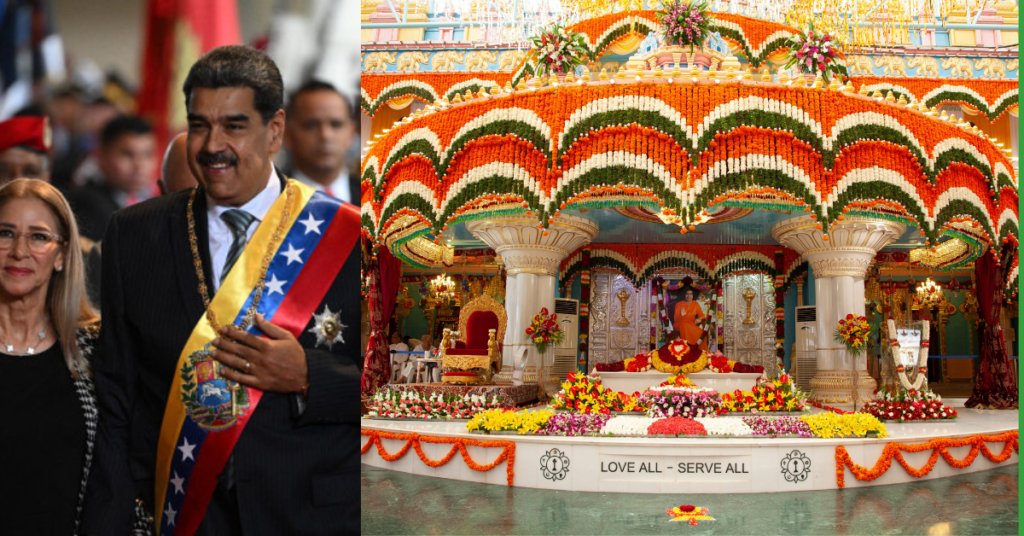
Long before Maduro became Venezuela’s head of state, his life followed a markedly different path. Raised in a Catholic household, he was introduced to Indian spirituality through Cilia Flores, years before their marriage. Reports indicate that Flores played a key role in guiding Maduro toward the teachings of Sathya Sai Baba, a spiritual figure revered by millions across the world for his messages of unity, service, and moral discipline.

Advertisement
This introduction gradually evolved into a deeper spiritual association. At a time when Maduro was far removed from presidential power and international scrutiny, his connection with India was driven by personal belief rather than political symbolism.
Visit to Prasanthi Nilayam in Andhra Pradesh
In 2005, nearly a decade before assuming the presidency, Maduro and Flores traveled to India to visit Prasanthi Nilayam, the primary ashram of Sathya Sai Baba located in Puttaparthi, Andhra Pradesh. Photographs from the visit show the couple seated on the floor among other devotees, reflecting the egalitarian environment encouraged by the spiritual leader.
This visit marked a defining moment in Maduro’s spiritual link with India. Unlike diplomatic visits that involve protocol and formalities, this journey remained largely private at the time, gaining attention only years later as Maduro rose to global prominence.
Influence during Maduro’s tenure as foreign minister
The spiritual connection did not fade as Maduro’s political career advanced. In 2011, following the death of Sathya Sai Baba, Maduro—then serving as Venezuela’s foreign minister—played a role in passing an official condolence resolution in the country’s national assembly. This gesture highlighted the lasting personal impact of the spiritual leader on Maduro, even as he navigated complex international responsibilities.
Observers noted that such a move was unusual in Latin American politics, where formal recognition of foreign spiritual figures is rare. However, for Maduro, the tribute appeared to stem from personal reverence rather than political calculation.
Symbolism and Indian spiritual elements in state events
Maduro’s spiritual link with India surfaced again years later through symbolic gestures by the Venezuelan government. During Venezuela’s National Day celebrations in 2024, invitations reportedly featured the sacred “Om” symbol, a motif deeply associated with Indian spirituality. While the inclusion drew curiosity, it also sparked debate among political commentators about the blending of personal beliefs with state symbolism.
In November 2025, Maduro publicly honored Sathya Sai Baba’s centenary, referring to him as a “being of light.” This statement reinforced the enduring nature of the spiritual bond, even amid escalating political pressure and international criticism.
A contrast between politics and personal belief
What makes Maduro’s spiritual link with India particularly compelling is the contrast it presents. On one side stands a leader accused of serious crimes and facing intense global opposition. On the other is an individual who sought spiritual guidance from an Indian guru known for advocating peace, service, and moral conduct.
This duality has fueled discussion about how personal belief systems coexist with political power. Supporters argue that spiritual influence may have shaped Maduro’s worldview, while critics dismiss the connection as irrelevant in light of current allegations.
Why this connection matters today
As Venezuela remains under international scrutiny, revelations about Maduro’s past continue to attract attention. His spiritual link with India does not alter the legal or political challenges he faces, but it adds depth to public understanding of the man behind the office. In a global environment where leaders are often viewed solely through political actions, such personal histories offer rare insight into formative influences.
For India, the connection underscores the global reach of its spiritual traditions. The fact that a Latin American leader once sought guidance in an Indian ashram highlights the transcultural appeal of Indian spirituality beyond borders and ideologies.
A lesser-known chapter in a turbulent political story
Maduro’s spiritual link with India remains a footnote compared to the larger geopolitical struggles surrounding Venezuela. Yet, it stands as a reminder that political figures often carry complex personal histories that shape their journeys in unexpected ways. Whether viewed as a sincere belief or an intriguing historical detail, the connection continues to resurface whenever global attention turns toward Caracas.
As international developments unfold, this little-known bond with India offers a rare pause from conflict-driven narratives, revealing a chapter of reflection, faith, and personal transformation in the life of one of Latin America’s most controversial leaders.